My PhD thesis ‘(Un)dressing the Love Symbol: The life, death and legacy of Prince’s wardrobe’ (Northumbria University) is the first comprehensive study of Prince’s dress. It explores the cultural influences, materiality, labour processes and afterlives of Prince’s wardrobe.

Drawing from fashion, cultural and film studies, this thesis adopts a mixed-methods qualitative approach utilising semi-structured interviews with former Prince creatives and fans, an online questionnaire, textual analysis, object analysis, and creative autoethnographic approaches. Adopting a combination of watching, drawing and self-reflection, I have devised an ‘embodied looking’ framework for popular cultural representations and objects that encourages researchers to slow down becoming aware of their responses to the dressed moving body on screen, in addition to the thorough documentation of dress.

Prince’s public and private sartorial image was performer-led and facilitated through the active collaboration between designer/makers. Uncovering a discourse of dress through liaising with marginalised voices of creatives provides a greater understanding of Prince’s star-performer image beyond journalistic representations. Fans demonstrate an embodied connection towards Prince’s dressed moving body. The term ‘embodied intimacy’ moves beyond wider iterations of fan fashion including closet cosplay and cosplay to a less explicit fannish dress practice that centres upon an embodied sense of style, inspired by the musician. Furthermore, the term is adopted as a means to convey the visceral bodily reactions experienced by the audience when watching Prince. Liaising with fan and private collectors can enrich and diversify representations of Prince in museums and institutions, disrupting the hierarchies and practices of conservation and curation.
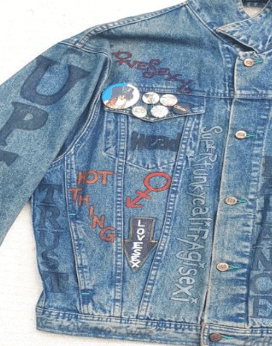
This thesis places dress analysis at the centre of an interdisciplinary examination of the production, representation, consumption and afterlives of a performer’s dress. The findings demonstrate the embodied connections between audiences, star-performer and dress. This research offers an approach that can be adopted beyond fashion studies into and across disciplines including film, media, celebrity, music and fan studies.
Read published work here.
 CASCI RITCHIE